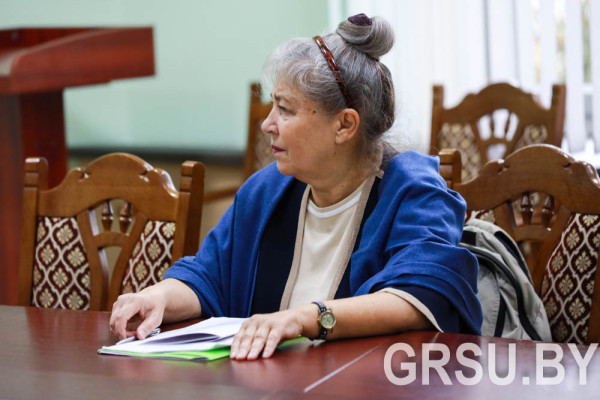
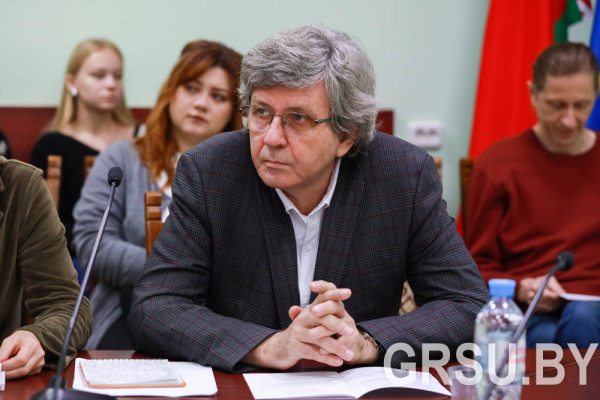
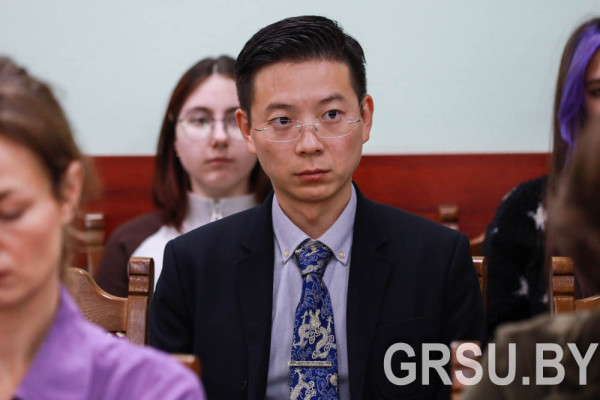
The 21st International Scientific Conference, "The Interaction of Literatures in the Global Literary Process: Issues in Theoretical and Historical Poetics," has begun at Yanka Kupala State University of Grodno
The three-day academic forum, running from September 24 to 26, has brought together researchers from Belarus, Russia, and various other countries. Participants are engaging—both in-person and online—in discussions on key issues in contemporary philology.
During the opening ceremony, Anton Glazev, Head of the Research Department, addressed the participants on behalf of the university administration:
"For over twenty years, this conference has served as a respected platform for scholarly dialogue among leading philologists from various countries. Its scope is extensive, covering topics such as comparative literary studies and the interaction of national literatures within a global context. The forum unites scholars from across the globe, and it is precisely within this space of intercultural dialogue that perspectives on the contemporary literary process are shaped and pressing academic questions are addressed."
Anton Glazev wished the participants engaging and productive discussions—ones that would lead to new ideas, new contacts, and further academic collaborations.
"Today, philology has become vital," noted Svetlana Gonchar, Dean of the Faculty of Philology, in her welcoming remarks. "The modern era and new technologies often push us toward simplification. The world demands quick answers, instant solutions, and concise formulas; yet, in such an environment, literature remains the one thing that allows us to think deeply and deliberately, to seek out new meanings. This is precisely what we are doing at this conference: upholding the right to complexity and depth—the right to poetry within our discourse. The very title of this conference becomes more relevant with each passing year." Today, "interaction" should be understood as an alternative to "isolation," for it is only through a collaborative quest—and through literature itself—that we can overcome the challenges posed by the modern era.
It was noted that this conference has become a hallmark of the Faculty of Philology. For many years, its driving force and "magnet"—attracting prominent scholars from across the post-Soviet space to Grodno—has been Tatyana Yevgenyevna Avtukhovich, Doctor of Philology and Professor.
Following the opening ceremony, a plenary session took place. The first speaker was Snezhana Semernik, Head of the Department of Philosophy at Yanka Kupala State University of Grodno (YKSUG), Doctor of Philosophy, and Professor, who presented a paper titled "Human and AI: Horizons of Interaction." The plenary session also featured seven additional presentations by leading scholars invited from Belarus and Russia.
The conference will continue with breakout sessions. Participants will explore a wide range of topics, including national themes within texts; the problematization of the boundary between fiction and reality; textual integrity; the narrative of everyday life; the representation of time through various genres; the role of language and boundaries in literature and art; the typology of contemporary archetypal figures; genre and stylistic developments in Belarusian literature; and the search for new approaches to studying the world and the text.
The conference is organized by the Department of Russian Philology at Yanka Kupala State University of Grodno.